Features / AI agents · MCP
Point your AI agent at production.
Connect Claude Code, or any MCP client, and it pulls the real context itself: the whole causal chain behind the failure, down to the query and the job. An alert fires, you ask “why is checkout failing?”, and the agent fixes it on the first try because it can see what actually happened.
Connect
One command, read-only access.
Run it in the repo you're debugging; grab the command with your key from Settings → API keys. Each key is pinned to one project and environment, shown once, and revocable. Available on Solo and up.
$claude mcp add --transport http unravel https://api.unravel.run/mcpRead-only · scoped to one project & environment · the agent can look, never mutate. It sees every trace in your window, not a sample.
The exact tools, scope and limits are in the docs.
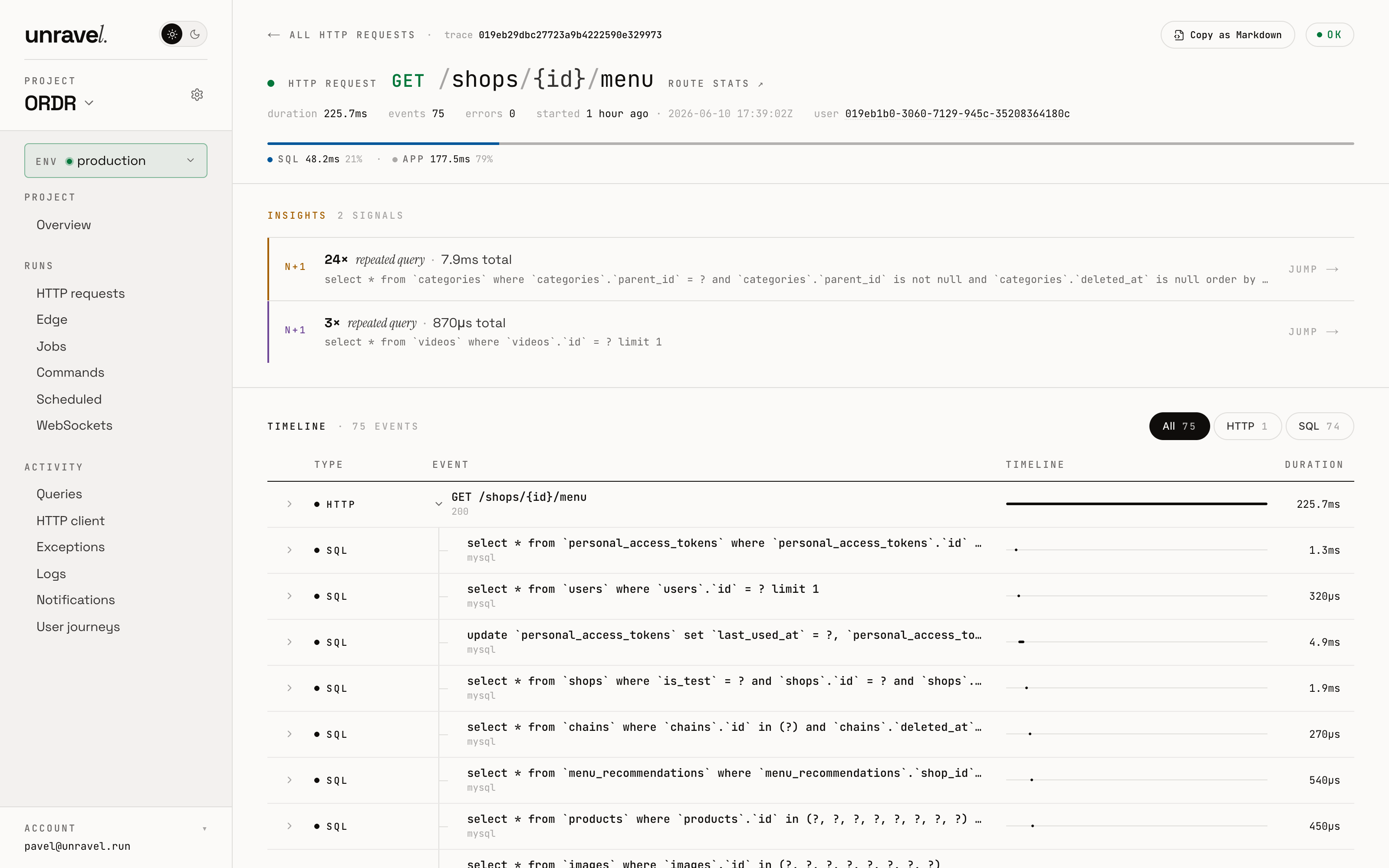
The live context the agent reads: 75 events, two N+1 clusters, the SQL and the user's journey, interpreted into a story it can act on.
Or hand it over yourself
No MCP? Copy as Markdown.
Open any trace and press Copy as Markdown: the failing span, immediate cause, normalized queries, N+1 clusters and the user's journey, as text. Paste it into Claude Code, Cursor, or anything else.
Keep exploring
The rest of the toolkit.
Async is where PHP apps break.
Websockets, queued jobs and scheduled work are traced like requests, with their own queries, failures and timing.
ExploreCausalityCausality, not log soup.
Normalized query fingerprints, collapsed N+1s and user journeys; every failed trace carries its immediate cause.
ExploreAlertingKnow before your users do.
Rules on new exceptions and error spikes, delivered to Slack, email or webhook with the debugging context inline.
ExploreStop reconstructing incidents from logs.
Connect your real app in two minutes. Free forever on a 3-day window, the full debugger included.
Start free